Our vision is important, demanding that we take the best possible care of it. So when you search for a good optician in Napa Valley, whether you are looking in Napa, Calistoga, Yountville, American Canyon, or St. Helena, you are looking for the best practitioner you can find.
Opticians are eye care professionals who fill prescriptions from eye doctors, including optometrists and ophthalmologists, to help patients see clearly by fitting them with eyeglasses or contact lenses. Some opticians actually grind the lenses to prescription. Most work with the patient to get the appropriate measurements, then send all the information to a laboratory for processing. Opticians, sometimes called dispensing opticians, may work in the doctor's practice, or they may work independently or as part of a chain. It can be a bit confusing to know which optician you want to use. Take a few minutes and use the articles below to help you understand what to look for in an optician.
Good opticians in Napa County may advise on the fit of new glasses frames, the type of eyeglass lens used, or help you learn about contact lenses. They can only fill prescriptions, they can never write a prescription. An ophthalmologist is a medical doctor (MD) who has completed training including a residency; he or she can prescribe lenses to correct vision and can perform eye surgeries. An optometrist is not a medical doctor, but is allowed to treat certain eye conditions such as nearsightedness or farsightedness. The optometrist's training is less extensive than that of the ophthalmologist; for example, there is no residency period. As a consequence, the optometrist treats a limited number of conditions. The conditions he or she may treat are based on the state in which they practice.
How Do Napa Valley Opticians Help Me with my Vision?
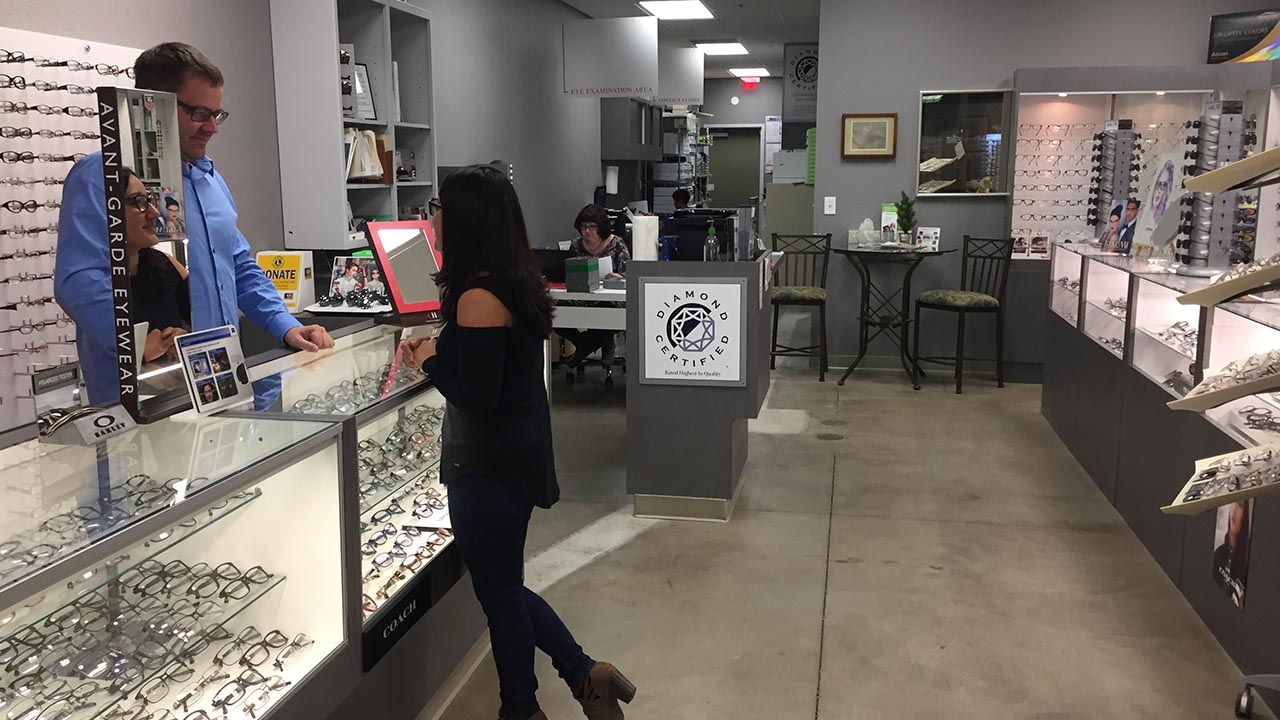
Your local optician in Napa Valley, whether in Calistoga, Yountville, American Canyon, Napa, St. Helena, or the smaller areas of Angwin, Deer Park, or Oakville, fits glasses to suit you. They can also help train you to put in, take out, and care for contact lenses. The optician's services are not available in an online store; the services include advice about frame size, frame fit, and frame suitability for your prescription. The optician can also help you practice how to put in contact lenses and take them out. The optician can help you learn about the maintenance schedule for your contact lenses. You may have disposables that must be replaced daily, monthly, or at some other interval. Or you may have contact lenses that last for a year and need proper removal and cleaning.
Finding a Good-Fitting Frame in Napa Valley
Whether you are looking in Angwin, Deer Park, Rutherford, Pope Valley, or Oakville, you will find eyeglass frames of all types and descriptions. Your optician should be able to help you find your best glasses. Typical criteria include what suits your face, your price range, any allergies you may have, and what you will be using the glasses for - whether for work, inside use, or for sports or other activities where durability is key.
You can find frames made of many materials. These range from plastics and metals to some more esoteric designs in bamboo, or other woods or unusual materials. Your trained optician should be able to describe the benefits of the different frames. Different patients have different needs. Some patients need materials that will not cause allergies, while others need super light or super durable frames. Among metal frames, titanium and beta-titanium are popular for frames because of the material's strength, durability, light weight, and ability to resist corrosion. There are some particularly flexible titanium-based alloys where the metal will spring back into shape after being twisted or bent. Ask your optician about the costs of the frame. Titanium alloy frames often cost less than all-titanium frames, but the flexible alloys may cost more. These are just some of the options you can choose for metallic frames.
The nature of plastic allows for many different frame styles. Many plastic frames are made of cellulose acetate, also called zyl. Modern plastic frames are also frequently made of nylon materials. Hypoallergenic plastics are available. Plastics have the ability to take on many colors, making them a good choice for fashionable looks. Nylon-based plastics are often used for wraparound styles or for sports frames. Ask your optician about the benefits and drawbacks of different materials. For example, while plastic-based frames are often less expensive than metal frames, plastics tend to break more easily. Plastics can become slightly weaker over time as they get older and if they are exposed to sunlight. They have the potential, like all plastic, to burn, but it's rather difficult to start them on fire.
Find out what your optician does to cater to children's needs. Your children might have special needs your optician can advise on. Sometimes very young children need eyeglasses with special temples that help the glasses stay on the head. Durability and a light-weight frame can also be important considerations for children, along with spectacles that are that do not arouse allergies.
Measuring for the Best Fitted Frames in Napa Valley
You will find several measurements are required to fit your frames properly. The most important measurement when it comes to fitting your glasses is the PD, also called the pupil distance or pupillary distance. The optician will use a special device to measure the distance between your pupils. This measurement is critical because the center of the lens should be centered over your pupils. If the lens is not centered correctly, unintended prisms may be introduced that can harm your vision. Having an accurate PD is especially important with stronger prescriptions.
The optician should take care to adjust the fit of the frame over the bridge of the nose. There may be pads at the bridge that can be adjusted for fit. The glasses should not squeeze the bridge of your nose, nor should they slide down it.
The frame's temple passes along the side of the head and curves over the ear. It should be long enough to rest on the ear without pressing on the ear. The frame itself should be wide enough - slightly wider than your face - so that the temples don't press into your head.
Once you have what you think is a good fit, test the glasses. Bend over to pick something up, shake your head, and perform other typical motions that will test how the frames work on your face.
Selecting Lenses in Napa Valley
Your optician, whether you are being fitted in Calistoga, Napa, American Canyon, Yountville, St. Helena, Deer Park, or Rutherford, fills the prescription written by your optometrist or ophthalmologist. Opticians can sometimes make recommendations that enhance your prescription. A heavy, thick plastic or glass lens from a strong prescription may be too heavy for the frames of your choosing. Your optician may be able to suggest alternatives such as high-index plastic lenses that are thinner and lighter than traditional glass or plastic lenses. The high-index lenses use less material to bend the light going into your eye. High-index lenses may be especially beneficial for stronger prescriptions. Polycarbonate lenses can be very durable and are often high-index.
A high-definition lens comes in several types. High-definition lenses take more account of the patient's eye shape, which may allow them to correct for eye aberrations other than nearsightedness or farsightedness. With free-form lenses, the optician will take additional eye measurements. The lenses will be manufactured on machines with very tight tolerances. Some of the additional measurements might include the angle of the eye in relation to the back of the lens in different positions, such as straight on, to the side, etc. With increased measurement, the high-definition glasses are customized to the patient. Other high-definition lenses, called wavefront lenses take into account the exact patient's eye. The lenses are then ground for that patient. For wavefront high-definition lenses, the optometrist or ophthalmologist will determine if the patient is eligible.
Consider using an aspheric lens. Standard lenses have one curve across the entire surface. An aspheric lens has a flatter curve. Depending on whether the correction is for nearsightedness or farsightedness, the lenses' curve will change, being fatter at the edges for nearsightedness and fatter in the middle for farsightedness. Many aspheric lenses are also made of high-index materials.
Giving Your Lenses a Long Life in Napa Valley
Your optician may recommend coatings to improve the live and performance of lenses. Anti-reflective coating is especially common with aspheric and high-index lenses. Since the aspheric lenses sit closer to the face and are flatter, it is easier to notice more reflections. Scratch-resistance coatings are also strongly recommended to improve durability. Do discuss options with your optician, though, since many lenses, especially high-index lenses, have scratch resistance already built in. Ultra violet coating - or UV coating - will block 100% of UV rays. A normal plastic lens will block most rays, and most high-index and other new lenses have UV coating built in already. Your optician should be able to tell you whether the coating is built in or needs to be supplemented. Some companies also advertise coatings that help reduce fogging.
Some Other Lens Options in Napa Valley
Photochromic lenses darken automatically when you are in sunlight. Some brands offer photochromic lenses especially for driving. These so-called sun photochromics have a pre-existing darkish coating on the glasses that darkens even more when exposed to the sun while driving. This darkish coating is required because the standard photochromic glasses did not darken enough to prevent all UV light from entering when in a car. Glasses may have other tints as well. For example, some sport hunters like a yellow tint, which allows for better contrast when skies are overcast.
Your optometrist or ophthalmologist might prescribe bifocals or trifocals. They may help you decide if you can use progressive lenses, which provide similar functionality, allowing users to change the distance at which they are focusing. Progressive lenses let users change the distance of their focus without having a line in the lens. When considering progressives vs. bifocals or trifocals, you should know that bifocals or trifocals may offer a wider lens area for a specific task. You may also be prescribed multifocal lenses for specific tasks, like working at the computer. There is some evidence that when children wear bifocals or the like, they reduce their nearsightedness, since the eyes don't have to focus so much for near tasks. Opticians can help you find the right frames and help you try on and adjust multifocal lenses.
Working With Contact Lenses in Napa Valley
Inserting and removing contacts are important techniques your optician must be able show you, whether fitting you in Calistoga, Napa, American Canyon, St. Helena, Yountville, Deer Park, Rutherford, or Pope Valley. Contact lenses come in different powers, diameters, and curvatures. The optometrist or ophthalmologist will determine which contact lenses are right for you based on your correction and your eye. When filling contact lenses prescriptions, with one very narrow loophole, opticians must fill the prescription with the brand prescribed by the eye care professional. The loophole addresses manufacturers who have generics for name brands. Your optician should help you feel comfortable with putting in and taking out the lenses your eye care professional has prescribed.
Like eyeglasses, contact lenses can resolve a number of eye issues. You can get contacts for nearsightedness and farsightedness, bifocal contact lenses, and the like. Even toric lenses are available. A toric lens allows users with astigmatism, who could never use contact lenses before, to wear contacts. Toric contact lenses to treat many conditions are available - including disposables, multifocals, colored, and the like. There are even contacts that perform orthokeratology. These "ortho-k" contact lenses shape the eye during use at night, allowing the user to sometimes go without wearing any corrective lenses during the day.
When it comes to contact lenses, you find yourself wearing either soft lenses or gas permeable (RGP) lenses. Soft lenses are made from soft plastics containing water. The water is used to carry oxygen to the eye. Gas permeable lenses allow more oxygen to the eye. They tend to be smaller than soft lenses. Since gas permeable lenses do not cover as much of the eye, users may find them less comfortable initially. They provide many users with better vision than the soft lenses. A new kind of soft lens, called silicone hydrogel, is also available. It is a soft lens that allows oxygen into the eye. As such, silicone hydrogel is a good choice for those who want to sleep in their contacts. Your optician should be able to provide you with information on how to get used to your contact lenses, no matter what type they are. Fun contact lenses are also available - to change or deepen eye color, for example. Even contact lenses that are for purely cosmetic use, such as changing the eye color, must be prescribed by an optometrist or ophthalmologist because all contacts are medical devices.
Maintaining Your Lenses on Schedule in Napa Valley
Wherever you are in Napa Valley, whether in Calistoga, Napa, Yountville, St. Helena, or American Canyon, you need to learn from your optician how often to replace contact lenses. Gas permeable lenses may be worn for a year, or however long you go between doctor visits. Soft contact lenses may be disposed of on a variety of schedules, including daily, weekly, monthly, or other times. Ask your optician about the replacement period for your lens. For contacts that you wear longer than a day, ask your optician about cleaning and storing your contacts. Soft contact lenses have an expiration date. You should take account of the expiration date. Soft contacts are packed in fluids that have the ability to become contaminated. You would not want to place contaminated material in your eye.
How Do You Discern Who's a Qualified Optician in Napa Valley?
Whether in Calistoga, Napa, American Canyon, Yountville, or St. Helena, you'll find many opticians to choose from, in many different kinds of settings. You might go to one of the chain stores that specialize in filling prescriptions. Or you might work with someone in your optometrist's office. In any case, find out who you will work with and their qualifications.
The Registered Dispensing Optician (RDO) in California must have a license from the state. These are the companies (whether consisting of one person or multiple people) that fill the eyewear prescriptions. The state also provides licensing for Registered Spectacle Lens Dispensers (SLD) and Registered Contact Lens Dispensers (CLD). These latter two are the people who are permitted to fit and adjust spectacle lenses and contact lenses, respectively, at a company that has an RDO license. The SLD and CLD must always display their licenses at work. The state also requires that out-of-state vendors that deliver contact lenses at retail to California addresses be licensed as Registered Nonresident Contact Lens Sellers. The Medical Board of California manages these licensing programs.
Doctors are prohibited from any financial relationships with an RDO, including landlord/tenant. So if you get your contacts or glasses at your optometrist's or ophthalmologists, you will not be working with an RDO, SLD, or CLD. You will be working with technicians who perform under the supervision of the doctor or optometrist. The technicians may have voluntarily chosen to get a certification from the American Board of Opticianry or the National Contact Lens Examiners. These groups require training and ongoing education for those who wish to become certified. However, neither this voluntary certification nor any state licensing is required for technicians working the doctor's or optometrist's office.
View/Print