
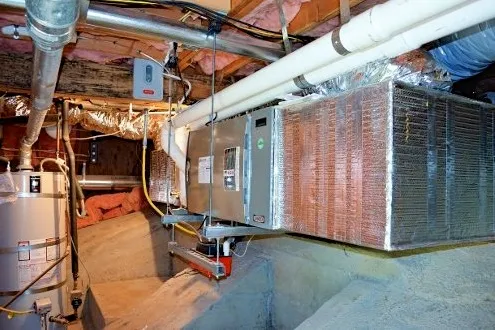
SOUTH SAN FRANCISCO — Many consumers assume all furnace filters are basically the same, but there’s actually a wide variety of grades and styles to choose from. One of the major ways in which filters differ is in regard to efficiency—an attribute that can substantially affect indoor air quality.
The higher a filter’s efficiency, the more airborne particles and contaminants it’s able to filter out of a home’s airstream. For example, while a standard $5 filter is only 7 to 10 percent efficient at filtering out particles, a $20 pleated filter will typically perform at 30 to 35 percent efficiency. For those with severe allergies or respiratory problems, a high-efficiency filter is a great choice—it catches 94 to 99 percent of airborne particles, including contaminants like bacteria, microbial spores and pollen. While high-efficiency filters can range in price from $125 to $150 apiece, they only need to be changed once a year, whereas the cheapest filters need to be changed every one to two months.
Before choosing a filter for your home, it’s a good idea to consult a licensed HVAC professional about the best option for your particular furnace system. In some cases, high-efficiency filters can cause performance problems with incompatible furnace models, so make sure you get some expert advice prior to making your selection.